The markets are closed today, therefore, no signals and no research.
However, I want to thank you for all the kind words I have received over the past three months since I launched Sharpe Two.
What was originally a “let’s help a dear friend get a view on how, as an ex-prop trader, I think about options” became quickly a newsletter followed by almost 500. I can’t thank you enough. I wrote a few weeks back that retail trading is a much lonelier game than one thinks: you made it a social activity again.
Outcry trading with LLMs agents
There is also a much more practical reason why I have started Sharpe Two.
When I went back to trading, I grossly underestimated how different it was from being an employee in a financial institution. You eat what you kill. And when you get seriously wounded one, two, three months in a row, hunting becomes terrifying. That happened to me earlier last year when I thought that I could take a plane every week and see the world while managing an option book on the side.
Things gradually improved once I was fully committed to it: be there for the open, be there for the close, do your research, know your customers, manage your inventory carefully, have a plan, and stick to it.
The ironic downside of a trading career is it doesn't allow you to invest at full capacity. As a business owner, you have fixed costs at the expense of the compounding effect observed in a buy-and-hold portfolio. A concrete example: because I pay myself every month, my partner ends up having a better year-on-year performance than me, Mr. I-look-at-the-market-every-day.
The moral of the story is you can’t have your cake and eat it. Sure, the kind of spike we had last week is a nice bonus paying for a lot of immediate expenses. Yet, the nature of the business is that the x amount of money you withdraw every month is less buying power and investment capacity you have at the end of the year. Depending on your account size and your living expenses, it can be substantial.
In the end, I publish research for very selfish reasons:
1/It keeps me committed every day to the desk, and to the necessary discipline to be a successful trader.
2/It allows me to cover some of my fixed costs without touching my trading account.
I won’t pretend that I don’t need the money because I’m already by the beach sipping champagne while selling covered calls or puts on stock I like to own… B*** please …. Here is another reason why I keep publishing research - there is so much garbage out there, and if I were to start now, I wish I could have easy access to a reliable source of information, not sugarcoating the risks and the difficulty of the game.
The last thing is I’m a generalist. I have always been curious about a multitude of topics: science, economy, maths, computers, geopolitics, philosophy, and sports (I put it in the end, but really, it should be the first one). The downside of being a generalist is that you are an expert at nothing.
For the longest time, I felt less than the quant who studied at the top financial programs in France and could price complex derivatives. For the longest time, I felt less than a computer scientist who could write good code with their eyes closed. For the longest time, I felt less than an entrepreneur with an actual eye for business opportunities.
The day I first hit the publish button on Substack, I stopped caring. Putting yourself out there helps you look at yourself with objectivity. All of a sudden, the distorted voices in your head get dissolved in the feedback, and you assess your work for what it is. It helps grow confidence, and for generalists with impostor syndrome, that is a serious source of edge.
Today, I am okay with being just a retail trader. I am okay not being a quant and just a data guy. I’m still not a software engineer, although most of the analyses you receive are the results of countless hours of code (python, SQL, and Spark for the geekiest of you here). I am not a data architect, but I have to deal with a few TB of data, and I am thinking about transitioning all that stack into the cloud soon.
I am also an entrepreneur - I help retail traders and low-capacity investors narrow the gap with best-in-class prop trading operations. I won’t help you become Citadel for sure, but I can get you away from MT5 and technical analysis and start focusing on what matters.
Ultimately, receiving messages saying, “I ditched the chart because of you,” or “My Pnl is happier now that I read you,” is as exhilarating as shorting a spike in the VIX and observing it mean reverts. I would even argue, for me at least, that it feels even better: sharing is caring, and I sleep better at night knowing I have a positive impact on someone’s financial decisions. I’ve seen firsthand the cost of gambling millions of dollars on stuff doomed to fail - it’s ugly, and it will be a story for another post.
Right now, do not hesitate to reach out: we can talk trading, we can talk strategy, but really, what we should be talking about is your risk profile: come with an extract of your recent positions, and I can give you some insights about what professional metrics would say about you, what you need to stop doing, and what you need to start doing.
If you can code, I have opened an API with most of the statistics used in Sharpe Two, so you don’t have to recompute it yourself. I am fully committed to making it better: test it and let me know how I can make it evolve to tailor your needs. Some said it’s expensive. I don’t think it is: these metrics are critical for a reliable trading operation, and it takes an awful amount of time to get them right. It’s like any service - compare the cost of doing it yourself to leveraging the expertise of someone else. That being said, whoever subscribes to a pro plan or above gets access to the newsletter for free and early access to Discord.
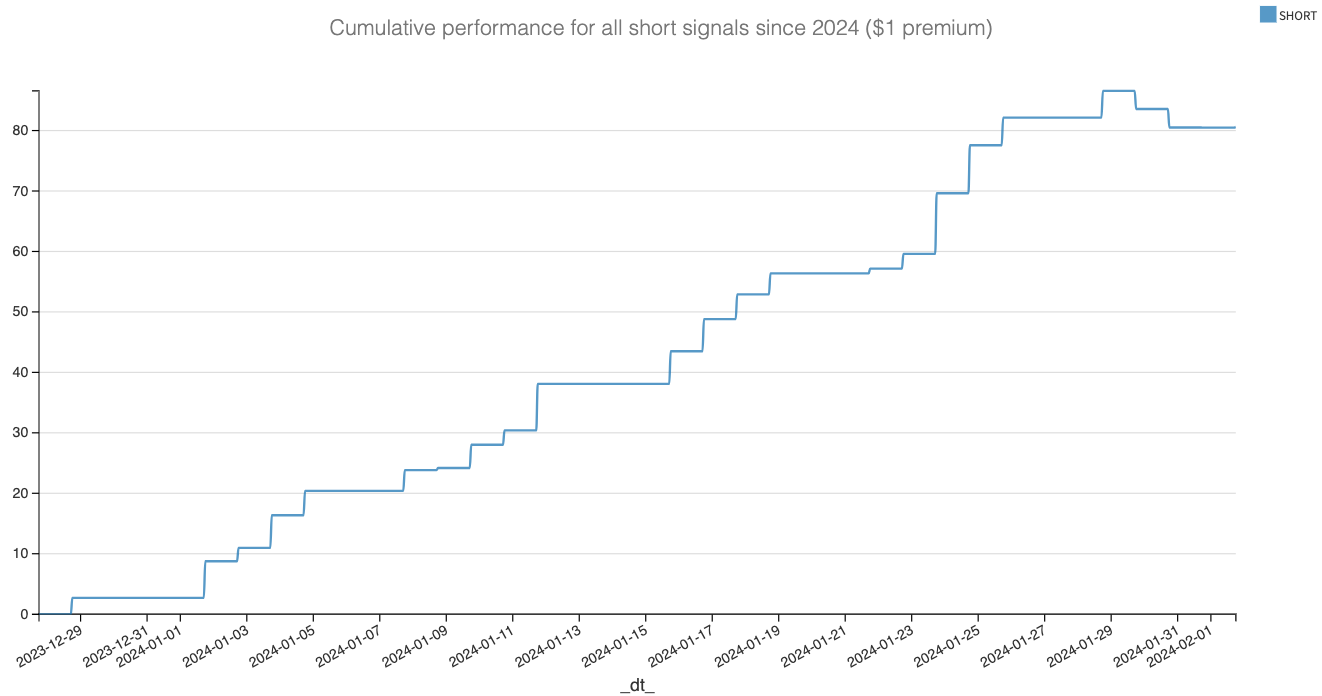
You will also find all the probability assigned to the Variance Risk Premium trades on ETFs I look at every day: the only little frustration with the newsletter is that I can point only to a few signals every week when, frankly, you should be able to tap into my research directly and decide which trade you want to take on and which one you don’t want. In the software world, they would call that research as a service.
I don’t like to boast PnL curve because they really mean nothing without the subtilities of real trading execution, but if that can help you get a dollar sign on the value of the API, here you go:
That is also why I am working on the Discord channel: I’ll post more interesting trades there on a daily basis, and we can keep talking about trading and many other things. Thank you for all of you who showed their interest, I’ll reach out in the next few weeks with something formalized.
Enjoy the day off the screen and happy trading.
Ksander