research · Sep 23, 2026 · 7 min read
Managing Volatility Without Running Out of Choices

Imagine the market has already sold off. Your book is down, the options you wish you owned cost more than they did last week, and another leg lower would hurt. You can buy protection, reduce positions, or wait. Unfortunately, none of those decisions comes with the prices you could have had before the move.
That is the uncomfortable starting point of Hari Krishnan’s The Second Leg Down: managing risk after losses have already occurred. It also gives some substance to a question recently raised by the Index Industry Association: how can investors manage volatility while maintaining flexibility?
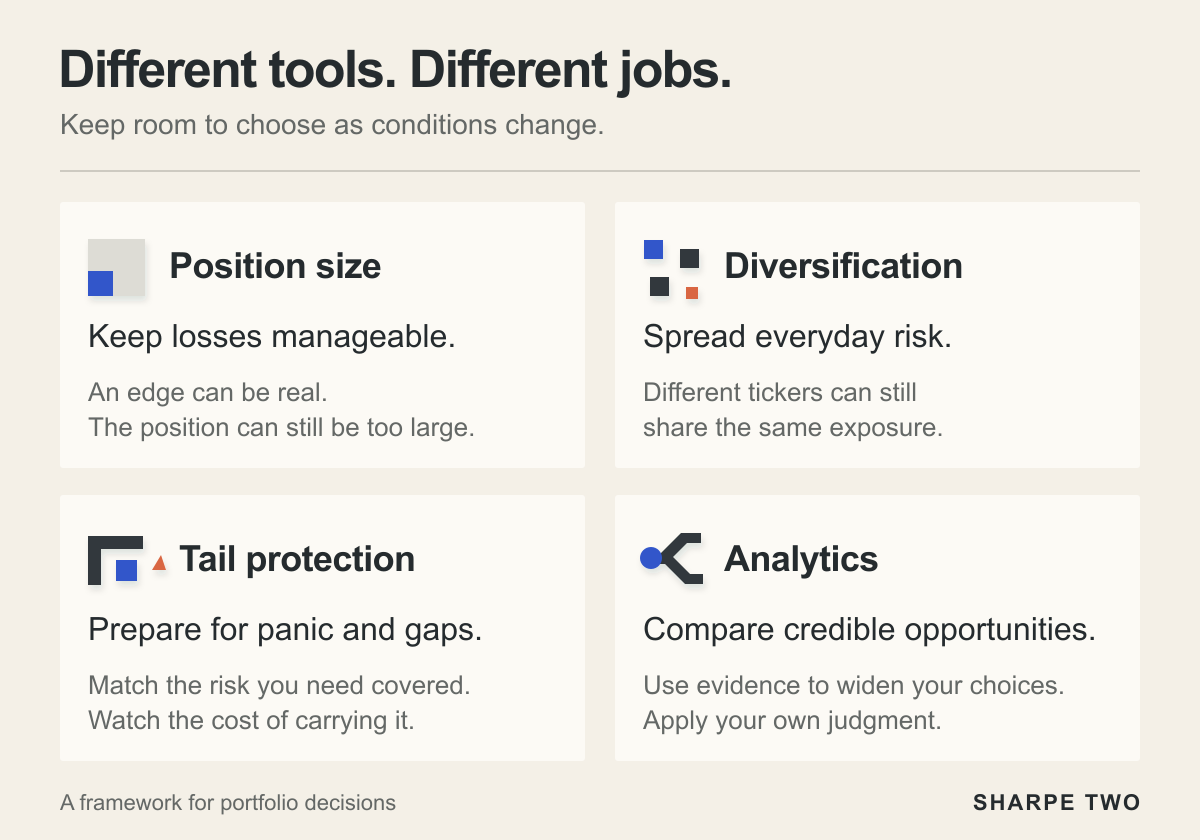
The choices available after the first decline depend partly on how the book was constructed beforehand. For an options trader, flexibility means still being able to choose: to absorb a loss, reconsider a view, and take the next opportunity without needing the current position to rescue the account. Building a book around that objective starts with how much risk you take.
In options trading, the best hedge is often a much smaller position: before buying another option, ask whether the short side should be smaller. Often, the answer is yes. We become obsessed with theta, thinking that the sole purpose of a hedge is to protect the amount theta pays us every day and that the hedge will protect the book when variance hits. A hedge can materially reduce the combined position’s risk, but it also changes the economics of the trade. Compare the hedged position with simply carrying a smaller one before committing more money to protection.
It sounds almost disappointingly simple. But a position that is too large can generate an endless sequence of expensive fixes. Buy a wing. Move the wing. Add another expiry. Hedge the delta. You can spend a lot of time managing a complicated position whose original problem was the number of contracts.
Sizing needs to start with what an adverse move would do to the account. Premium received and the broker’s initial margin requirement are poor substitutes for that question. For a short option, consider a jump in the underlying, a change in implied volatility, and worse exit prices together. Then consider several positions losing at once. A small ticket can carry substantial risk; smaller size also leaves an uncapped payoff uncapped.
The aim is to make losses financially and psychologically manageable. If one position can force you to abandon the rest of the book, it has too much control over your decisions. The edge may be real and the position may still be too large for your account.
Diversification helps with the ordinary experience of running that book. Different underlyings, exposures, and entry dates can keep one disappointing trade from affecting the whole book. It gives you room to experience variance and drawdowns while continuing to operate.
The familiar objection is that correlations go to one in a crisis. The limit of that argument is that true crises do not happen every weekend. Treat that as a stress scenario worth preparing for, not losing sleep over. Sure, you never know when the next event like August 2024 or Fukushima will hit, but as long as you are prepared for it, you can rely on other mechanisms in your day-to-day trading. In particular, the possibility of a crisis does not make diversification useless during the much longer stretches of normal market conditions.
Therefore, we give diversification and longer-term protection different jobs. Diversification helps spread everyday risk. Protection is there for the panic or gap that the book cannot comfortably absorb. Depending on the positions, that may include a violent rally as well as a collapse. An options book can get into trouble in both directions.
Selling volatility means accepting uncertain outcomes. The work is deciding whether the price compensates us adequately. Insuring every ordinary fluctuation is an expensive habit that can consume the very compensation we are trying to earn.
There is nothing wrong with choosing less risk. But the cost of the remaining protection should make sense for the exposure you actually intend to run. For comparable contracts on the same underlying with the same multiplier, counting one long contract against one short contract can be a useful starting point. Strike and expiry still affect the protection that pairing provides.
Judge the cost of protection against the loss it meaningfully offsets and the expense of maintaining it. A cheap option that barely responds to the risk you face can still be poor value.
Some accounts also have constraints that make coverage compulsory. A call calendar—a shorter-dated short call paired with a longer-dated long call—can be one structure to assess where the account’s rules allow it. The expiry mismatch introduces its own volatility and assignment considerations. Evaluate the price and expected behaviour of the complete spread; an attractive short leg does not establish the edge of the combined trade.
This is where high-quality analytics helps identify where the current evidence supports taking risk. Smaller positions in markets where that evidence favours implied volatility exceeding subsequent realised volatility provide a stronger foundation than collecting theta for its own sake. The opportunity has to be reassessed as conditions change, and a severe drawdown remains possible. But the decision to sell has a basis beyond “harvesting theta” or “generating income.”
Once the book’s risk is manageable, good analytics expands the range of trades you can justify taking.
Suppose you have identified two options trades, one in ETHA, which provides exposure to ether, and another in XLE, which provides exposure to energy equities. For this illustration, assume the estimated probabilities that implied volatility will exceed subsequent realised volatility are similar and sufficiently high to favour premium sellers. Also assume the opportunities are comparably attractive after considering their structures, holding periods, costs, and risks.
You are now fully back in the driver’s seat.
Perhaps you want energy exposure consistent with your market thesis. Perhaps the portfolio already has enough exposure to crypto. Perhaps your mandate excludes one of them, or the minimum position size is too large for the account. You can select the trade that fits the portfolio while retaining an evidence-based reason to take it.
You can now exercise discretion within a framework supported by evidence of an edge, and this changes the dynamic. Having a view can be expensive when it goes against what the data says. Conversely, discretion also matters when credible event risk changes faster than the model’s inputs can reflect it.
At Sharpe Two, realised-volatility forecasts, volatility risk-premium analysis, and surface context provide inputs for that comparison. What movement is expected over the relevant horizon? What is the options market charging for it? Where does the opportunity sit across expiries and strikes? How uncertain is the forecast?
The benefit is being able to identify several credible candidates and then exercise judgment to stay flexible and adapt to whatever new market narrative is unfolding. A model can find an attractive discrepancy in pricing without knowing whether you want another exposure of that kind in your account. That decision belongs to the trader.
The same process applies to protection. A cheaper hedge is useful only if it responds to the risk you need covered. Predictive analytics gives another layer of protection: it can also show that there is little worth selling today. Staying away and resisting the temptation to trade is already a first line of defence. There is no obligation to add weak trades just to offset the decay of protection you already own.
Start with the markets you already trade. Try Sharpe Two to compare volatility forecasts, risk premia, and option surfaces, then choose the opportunities that fit your book.
Discussion
0 COMMENTSLog in to join the discussion.