insights · Oct 22, 2026 · 9 min read
What Is Agentic Trading? From Market Data to a Trading Decision

On Friday, October 16, the VIX reached 22. Selling options into a volatility spike can feel uncomfortable. Our data pointed toward selling. That is the kind of situation where an AI trading agent can be useful: helping you work through a thesis, assess the opportunity and act on the numbers.
But first, it needs something meaningful to work with.
Agentic trading means using an AI agent that can choose and call tools to carry out parts of a trading workflow. It can retrieve market data, run calculations, assess an idea against your portfolio and submit orders through a broker connection. You decide which responsibilities and permissions to give it.
Connecting Claude to a broker through MCP, the Model Context Protocol, opens up those possibilities. The next question is what will inform its decisions. An agent needs market context, forecasts and business expertise to turn access to a trading account into a useful trading workflow.
Access to market data is only the beginning
Prices, volumes and standard indicators are useful inputs. They are also widely available. The same RSI and moving averages appear on TradingView, on your broker's platform and on your competitors' screens. Astra or Fable can calculate that crossover for you, but the calculation still contains the same information. A more capable model doesn't automatically give a familiar signal an edge.
There is another problem when an agent lacks market context: it can start hallucinating. It can invent an explanation for a move, refer to evidence it hasn't seen or present a guess as a fact. The result may read like convincing research even though the reasoning rests on something made up.
That becomes particularly dangerous when the agent is helping you decide where to put capital.
Useful datasets give it actual observations and forecasts to reason from. A volatility surface, a realized-volatility forecast or a positioning estimate adds information that an OHLC chart leaves out. With that context, the conversation can become specific: what is the market pricing, what is likely to happen, and where might the difference create an opportunity?
Decision models need business expertise
TypeSafe's Jev and OpenAI's Decisions API point toward a growing role for models that make structured decisions from supplied information.
For trading, the essential ingredient is business expertise. Someone still needs to define the question, identify the relevant inputs and understand what the answer means in the market.
In options, that means knowing which volatility measures to compare, matching their horizons, interpreting the surface and understanding how a forecast relates to a tradable position. Feeding a decision model more raw numbers doesn't supply that knowledge by itself.
Specialist data providers can put that expertise into the datasets they produce. They turn raw observations into forecasts, probabilities and analytics that address a specific trading problem. The agent can then use those outputs to assess a thesis in the context of the trader's objectives and positions.
This is why the quality of the provider's business expertise matters to the agent. A useful dataset carries decisions about what to measure and how to interpret it, as well as the numbers themselves.
So where should that expertise come from? You can build the research and data operation yourself, or use a provider that specializes in it.
Why specialist data providers matter
Gamma exposure, or GEX, shows how much work can sit behind a single number.
You could store open interest each day, archive the options tape and build an estimate of dealer positioning. You would need data engineering, storage, ongoing maintenance and options-market knowledge. Open interest tells you how many contracts exist; it doesn't tell you who holds them or which side dealers are on. An estimate built from public open interest therefore needs assumptions about ownership and direction.
Cboe's analysis of SPX 0DTE market impact illustrates why that positioning detail matters. Asking an agent to calculate GEX doesn't resolve the assumptions behind the calculation.
Building these analytics means taking responsibility for the research and the operation that keeps them useful. A specialist provider does that work as its business. The trader gains access to expertise without having to run a separate data and research operation.
At Sharpe Two, our expertise is options volatility. We produce realized-volatility forecasts and probability signals comparing implied volatility with what may subsequently be realized. These give traders and their agents a way to assess whether options look expensive or cheap relative to a view of what comes next.
That is the value of specialist data in an agentic workflow: it gives the agent a useful starting point for a trading decision.
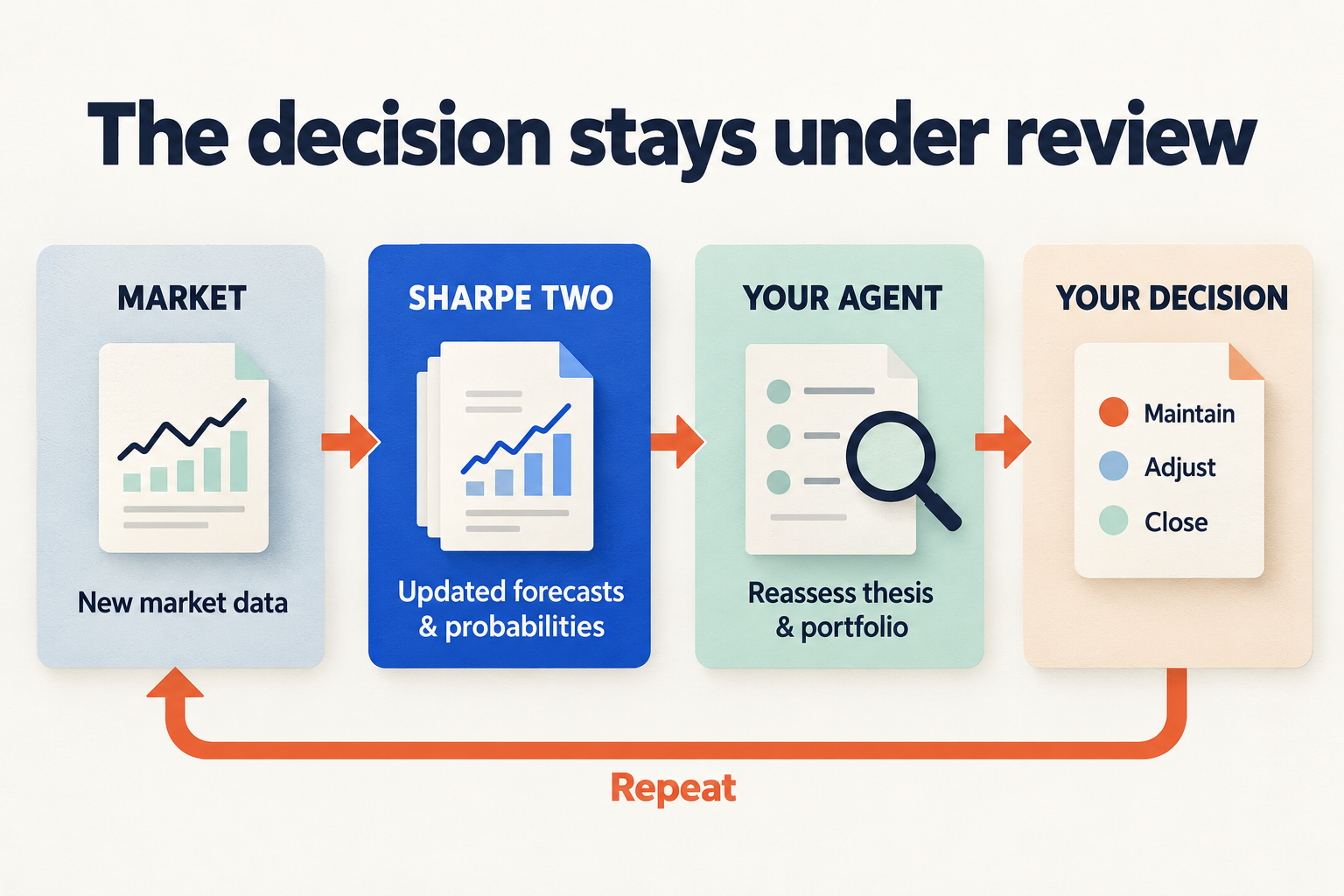
The market keeps moving. The decision stays under review.
From a volatility forecast to a trading decision
Consider the October 16 SPY snapshot discussed in our October 18 Forward Note. Our model assigned a 67% probability that SPY's 30-day model-free implied volatility at the bid would exceed realized volatility over the subsequent 30 calendar days.
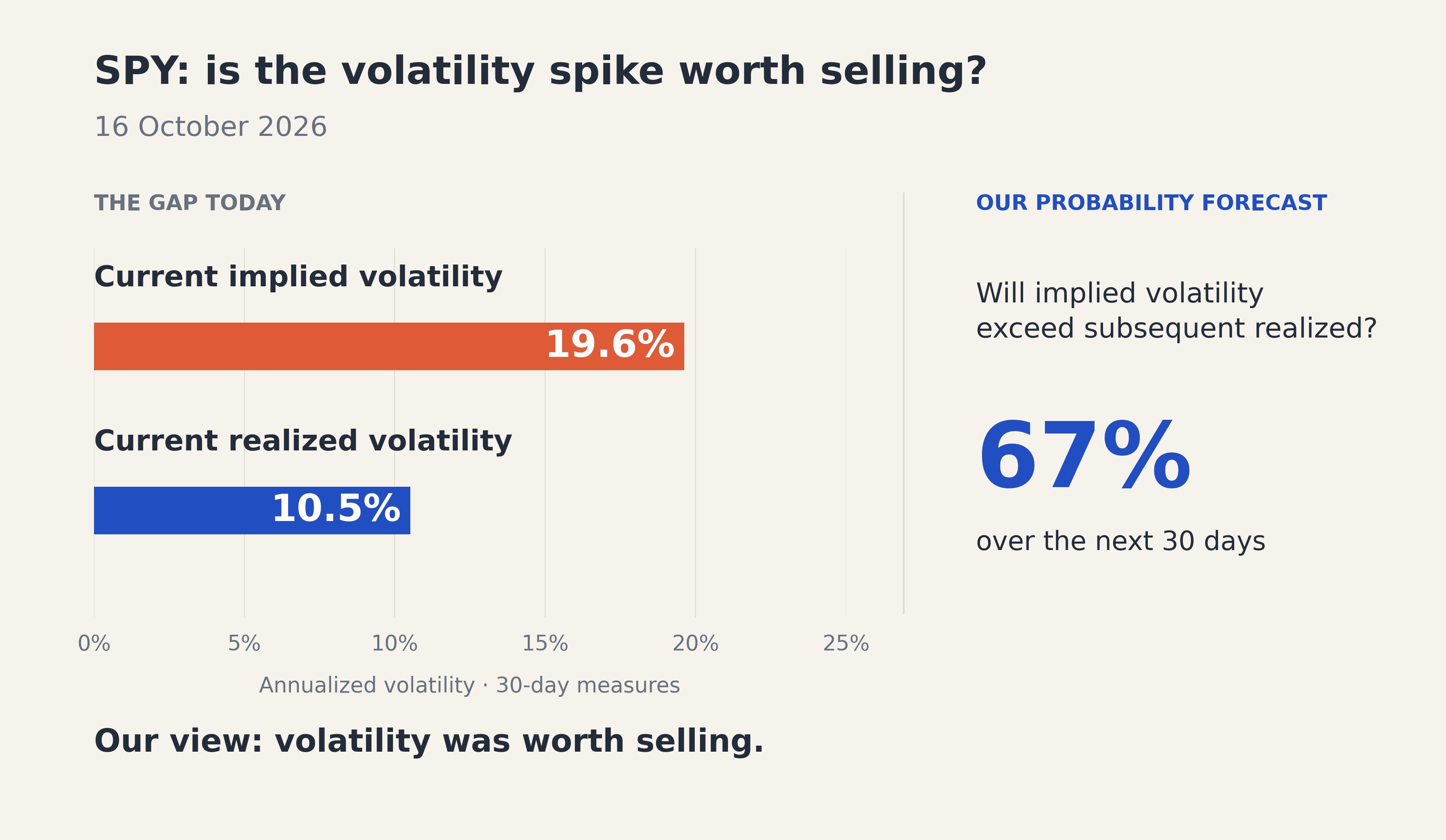
Today's volatility premium sets up the question: will implied exceed realized over the next 30 days?
Our conclusion was that volatility was worth selling, while recognizing that it could keep rising first.
That takes the conversation well beyond “the VIX is high.” There is a defined horizon and a probability supporting the thesis. An agent can use that context alongside option prices and portfolio positions to compare candidate structures, assess exposure and examine how the trade could develop.
The 67% describes the volatility comparison, not the probability that a particular trade makes money. The structure, costs, hedging and path still matter. An agent's next job is to help work through those choices: how much could the position gain, how much could it lose, and could the portfolio carry it if volatility rose further?
For example, the discussion could start with:
Given this 30-day volatility probability signal, compare the proposed ways to express a short-volatility view. Use the supplied option prices and portfolio positions to assess their payoffs, exposure and behavior if volatility keeps rising. Explain which structure best fits the stated risk limits and what additional information the comparison needs.
The forecast supplies the view. The agent helps translate it into a decision that fits the trader's portfolio. This is where specialist data and an agent's ability to work across tools become useful together.
Give the agent portfolio context
The same business expertise matters in risk management. A trade can be attractive in isolation and still add too much of an exposure the portfolio already has.
With access to positions and suitable analytics, an agent can assess delta, vega and concentration, compare scenarios and explain how a proposed trade changes the book. Several different tickers may still leave you exposed to the same market move.
Specialist risk tools supply the calculations needed to make those comparisons. The agent makes them easier to use in a continuing conversation: where is the risk concentrated, what happens under a volatility shock, and which adjustment would bring exposure back within the stated limits?
That conversation should continue after entry. Updated forecasts, changing option prices and approaching expiries can all change the decision. A workflow with current data and position monitoring lets the agent reassess the thesis and flag when action may be needed.
This gives portfolio context a place throughout the trading process, from selecting a position to managing it.
Decide how much execution to automate
A broker MCP can close the loop from analysis to execution. Using the tools and permissions available, the agent can turn an agreed trade into an order.
Once the structure and sizing rules are decided, tested code can apply them consistently. This is useful when a sound thesis feels uncomfortable to execute, as selling volatility during a spike often does. The calculation and order rules can be fixed in advance, with the agent working within those rules.
Execution can also remain entirely manual. Many traders we talk to want an agent as a sparring partner for research and analysis while keeping control of their orders. That division of work makes sense: the trader chooses which responsibilities to delegate.
The important point is that execution follows a thesis supported by data, with a position sized for the portfolio carrying it.
Start with a question about the market
Pick an underlying you follow and open VRP Central, our free tool comparing current implied volatility with recent realized volatility. It gives you a concrete starting point: what options are pricing against what the underlying has recently experienced.
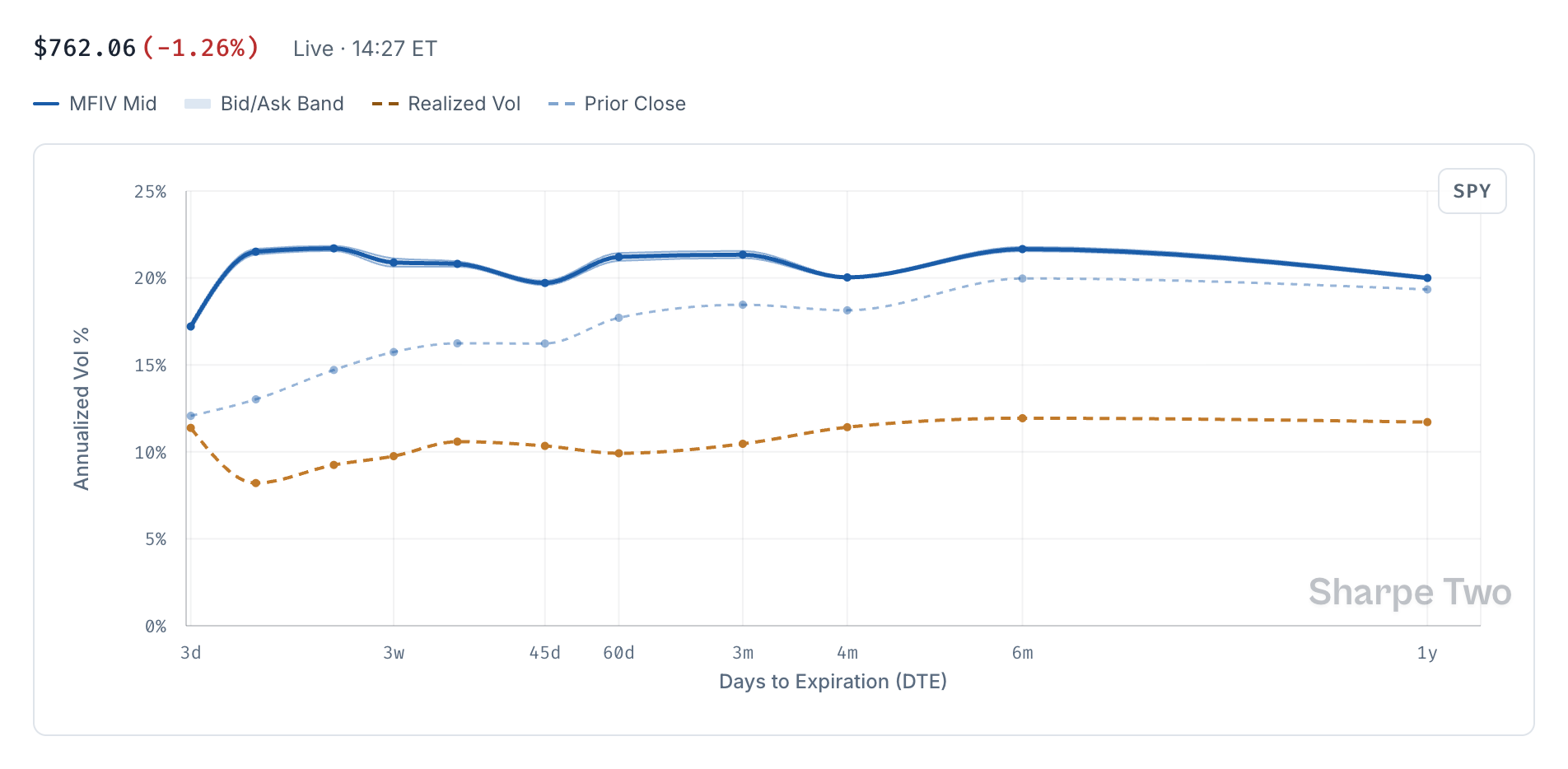
SPY during the volatility spike. The horizontal axis shows days to expiration. Blue is current implied volatility, dotted blue is the prior close, and orange is recent realized volatility.
From there, the question is what comes next. A forecast and a probability signal help develop that view; the agent can combine them with option prices, candidate trades and portfolio exposures.
That is what Sharpe Two contributes to agentic trading. We turn options-market expertise into forecasts and probabilities that give traders and their agents a stronger basis for making decisions.
Put Sharpe Two to work
Use Sharpe Two's volatility forecasts and probability signals to assess your next trading idea.
Start your 14-day trial for $14
Or explore VRP Central for free and compare implied and recent realized volatility for a ticker you follow.
Discussion
0 COMMENTSLog in to join the discussion.