insights · Nov 3, 2026 · 11 min read
AI Options Trading: Five Tasks to Delegate to Your Agent

Connect your favourite LLM to your broker through MCP, give it a few market data feeds and let it manage your money. That is the pitch behind a lot of the excitement around agentic trading. The agent does the work; we collect the passive income.
Anyone who has held an options position through a volatility spike knows how much is missing from that description.
LLMs can hallucinate. They can also retrieve the right numbers and draw the wrong conclusion because they lack the context to interpret them. The investment process involves several different jobs, and some are much better suited to an agent than others.
The useful starting point for AI options trading is deciding which responsibilities stay with us. Once those are clear, there are five tasks we would be very happy to delegate.
What not to delegate to your agent
The responsibility for the investment process stays with us. Agentic trading gives an individual trader the opportunity to act as a portfolio manager, with an assistant available to investigate ideas, run calculations and challenge a thesis. We still have to know what we are trying to achieve.
One of the most obvious things we would not delegate is simply “making money”.
Make 25% a year with a Sharpe ratio above 2. Make no mistakes.
While funny, this prompt highlights everything that is wrong with how agentic trading is currently framed: it skips the entire investment process. Where should those returns come from? Which risks are we prepared to carry? What would persuade us that the strategy has stopped working?
We need to choose a strategy we are willing to understand well enough to argue about with our agent. That includes accepting the uncomfortable part of the return. Selling options to harvest the volatility risk premium resembles selling insurance: we collect premium in exchange for carrying risk, including the occasional very expensive claim. Holding equities brings its own bargain, with drawdowns and periods of heightened uncertainty along the way.
An agent cannot make those trade-offs disappear because we asked for a smooth equity curve.
We also have to decide whether the evidence supports the strategy. LLMs can give us convincing answers that fit what we want to hear. A strategy can sound plausible and produce an attractive backtest while depending on fills we could never get, ignoring the bid–ask spread or assuming liquidity that was never there.
More data helps us investigate those problems. We still have to challenge the result. The money and the consequences are ours.
Finally, risk limits belong outside the agent's discretion. Let it calculate exposures, compare scenarios and flag a breach. Set the limits and enforce them through deterministic checks that can be tested and inspected. An agent may help write that code, but a persuasive explanation should never be enough to waive a position limit or approve an order that fails the checks.
With that framework in place, the agent has plenty of useful work to do.
1. Find opportunities worth investigating
Once we have chosen the strategy, it is reasonable to expect our agent to bring us setups that fit it.
For the short-volatility strategies we focus on at Sharpe Two, that means looking for situations where implied volatility is likely to exceed subsequent realized volatility. There will usually be several candidates, and the most interesting one may take some interpretation.
An agent can help with the straightforward exclusions. A stock reports earnings tomorrow, and we prefer to avoid that event. It can flag the earnings date and move on to another candidate.
The more useful work starts when the picture is less clear. Perhaps a probability is slightly below our usual screening threshold, but the premium is unusually large. Perhaps realized volatility or volatility of volatility is higher than we normally prefer, and we need to decide whether the pricing compensates us for it.
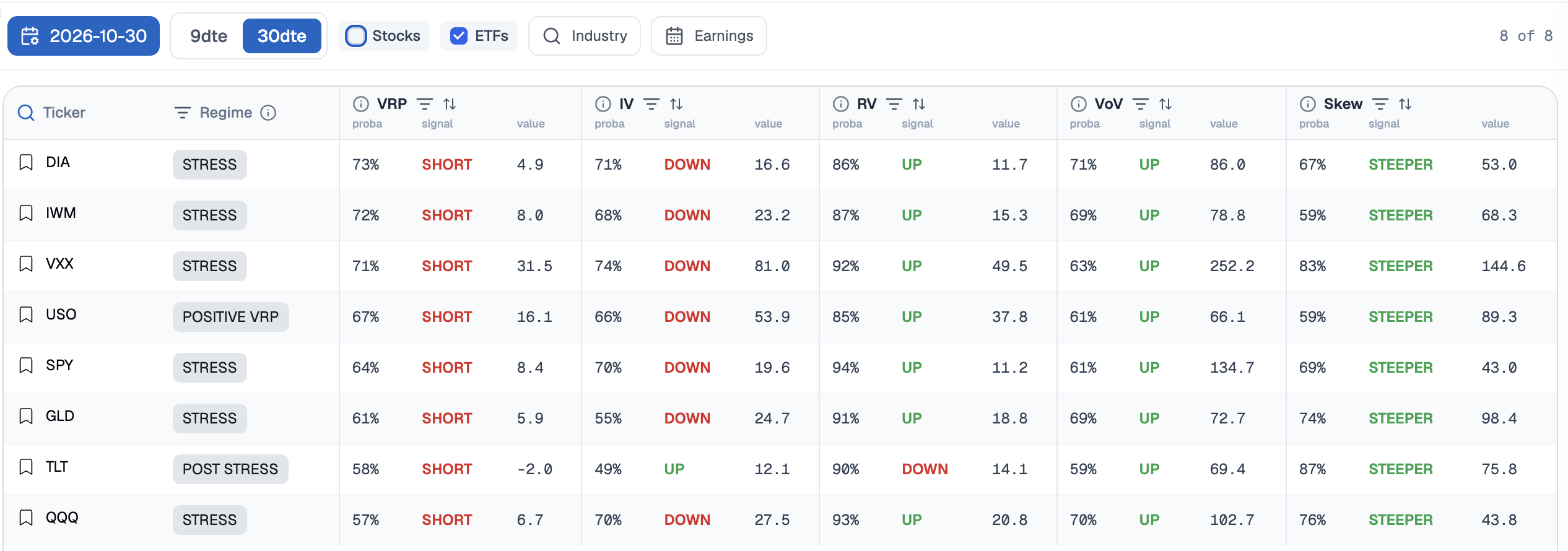
Sharpe Two's 30-day ETF signals for 30 October 2026. SPY shows a 64% short-volatility signal and an 8.4-point spread between implied and recent realized volatility.
Let's look at SPY after October's market rout. Its 64% signal is below the threshold we would normally consider, but implied volatility is 19.6% against recent realized volatility of 11.2%. Would we really dismiss an 8.4-point premium without a closer look, on something as liquid and usually stable as SPY?
The same row also points toward rising realized volatility and labels the regime as stress. Those observations belong in the discussion. We want the agent to put them together and explain why the opportunity deserves our attention, or why the apparent compensation may be less attractive than it looks.
A fixed screen can exclude a candidate in a binary fashion. An agent can bring an exception to us with the supporting context. And ultimately, we decide whether to trade it or not.
2. Construct the trade to express the view
How often have we had a view on volatility and then spent far too long deciding between a strangle, an iron condor and a calendar?
Options give us many ways to express a view. Each structure combines exposures differently, and choosing between them can become more demanding than identifying the opportunity in the first place.
At Sharpe Two, we often gravitate toward roughly 20-delta strangles because they fit our investment process and our portfolios. Another trader looking at exactly the same opportunity may reasonably choose something else.
Perhaps they expect the underlying to stay in a narrow range as implied volatility falls, making a straddle or tighter strangle worth considering. Perhaps their mandate requires defined risk. Would an iron condor or an ATM calendar be the better way to express the view?
This is where the agent can be a useful structurer. Give it the thesis, option prices, relevant forecasts, portfolio constraints and capital available. Ask it to compare the positions, recommend a structure and explain why it fits.
Structure, strikes and expiry belong in that comparison together. An expiry that looks attractive on a term-structure chart may fit the thesis poorly if the opportunity is expected to develop over a different horizon. Buying protection changes both the exposure and the amount of premium we retain.
Our SPY volatility-spike case study works through this choice using a strangle, an ATM calendar and an iron condor. The same initial view led to different exposures and different results.
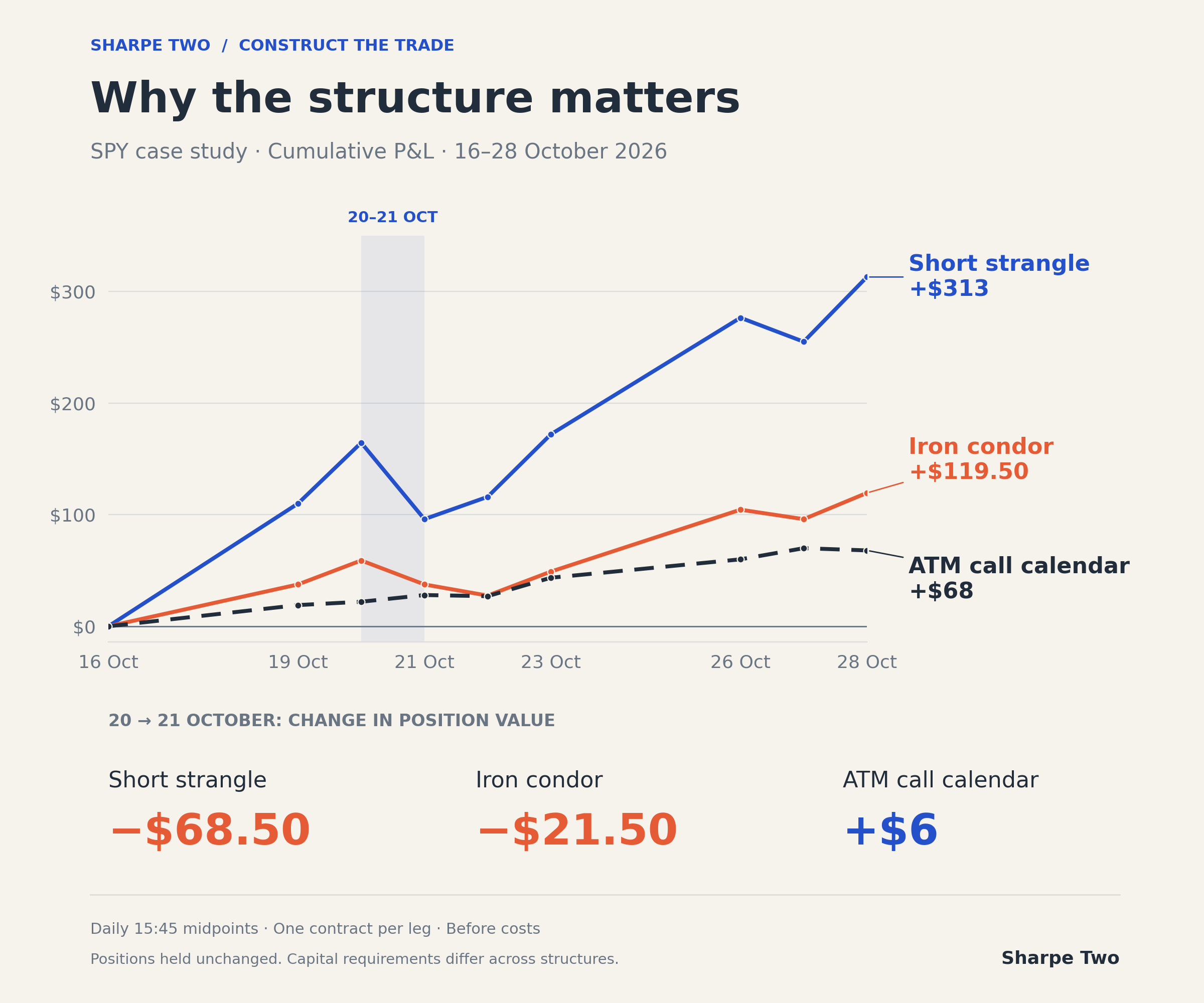
Actual daily marks from our SPY case study. The highlighted session shows how differently the structures responded to the same market. One contract per leg, before costs.
The useful output from the agent is a comparison we can make a decision from: why one structure suits our thesis and constraints, what we give up by choosing it, and what would make another structure preferable.
3. Decide whether the trade fits the portfolio
A trade can look like an absolute slam dunk and still be the wrong addition to our book. It may simply add more of a risk we already carry.
That is easy to overlook when we have become attached to an idea. We tend to assess each position as if it lives on its own, until a difficult market reminds us how closely the outcomes can be connected.
“Correlation goes to one” captures that uncomfortable experience. Positions that seemed different in normal conditions can start losing money together. We might be short some equity volatility and some bond volatility, yet a market shock can push both higher and put pressure on the whole portfolio.
An agent with our position data can make those overlaps visible. How much short volatility would the new trade add? Are several positions exposed to the same market move? Are too many expiries concentrated in the same week? What happens to the book if volatility rises across several underlyings at once?
It can then compare a smaller position, a different expression of the view or passing on the trade altogether. We get some distance from the opportunity we wanted to take and a clearer answer to the question that matters: does it improve the portfolio we already have?
4. Monitor whether the original thesis still holds
How many times have we prayed for a position to get back to breakeven, even though we knew we had stayed in the trade far too long?
We tell ourselves we will close it as soon as we get our money back. Market conditions have changed, but the price we paid has become the centre of the decision. We keep holding, and an exit that felt painful a week ago starts to look like a missed opportunity.
The market has no interest in helping us scratch the trade.
An agent can keep the original thesis in view and compare it with the latest observations. That gives us a more useful conversation than checking the P&L repeatedly and hoping for a recovery.
Sometimes the change is obvious: the premium we wanted to collect has largely disappeared. Sometimes it is much messier. The VRP and the probability signal may still look attractive, while volatility of volatility has risen substantially. The opportunity remains, but carrying the exposure has become more uncomfortable.
Do we keep the original size? Reduce it? Change the hedge? Has something changed that makes the remaining premium insufficient for the risk?
The agent can assemble the evidence for each choice and show what has changed since entry. That is more useful than mechanically waiting two weeks or anchoring on a particular exit price without revisiting why we chose it.
Trading involves decisions made with incomplete information. A regular comparison of the entry thesis with current conditions helps us recognise when flexibility is justified—and when we are simply looking for an excuse to stay in a position.
5. Explain what drove the P&L
We are particularly keen on this one. A profitable trade can conceal a poor understanding of what actually made the money.
Perhaps the thesis played out as expected. Perhaps a directional move rescued the position while the exposure we intended to profit from lost money. We can be grateful for the gain and still need to understand the difference.
That is what P&L attribution is for. It connects the result to the exposures we chose: delta, theta, gamma, vega and the interactions captured by Greeks such as vanna and charm.
In our SPY case study, one short strangle showed a $313 midpoint gain between 16 and 28 October. In the daily-snapshot attribution, theta contributed about $378, while gamma cost $199 and vanna cost about $8. Time decay more than covered those costs; the breakdown shows how much exposure we had to carry to earn the result.
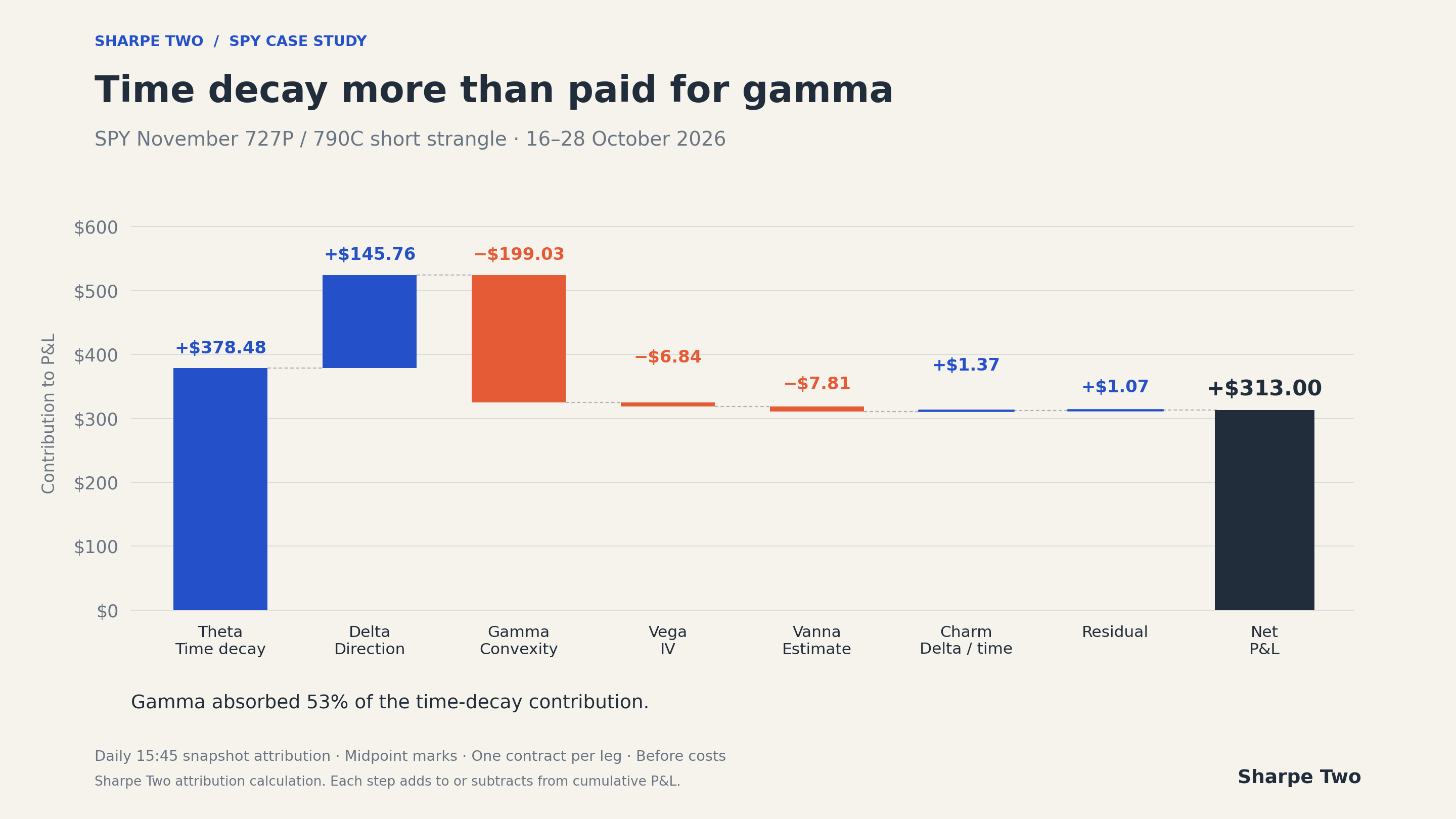
The $313 gain broken down by exposure. Daily 15:45 snapshots, midpoint marks and one contract per leg, before costs; vanna is estimated.
An agent using Sharpe Two's P&L attribution can work through that balance at the position and leg level, then compare it with the original thesis. It can examine the daily path and identify when the main contributions accumulated. We can then discuss whether another structure, a different hedge or a smaller position would have suited the opportunity better.
The question is also useful after a loss. Did the strategy encounter a risk we understood and accepted? Did we choose the wrong structure? Or did we keep a position after the original reason for holding it had gone?
Replaying the hand, winning or losing, is part of learning where our edge comes from. An agent makes it easier to do that review consistently, with the actual calculations in front of us.
Put your agent to work
Most of us already have a trade we would like a second pair of eyes on: an opportunity we have not had time to investigate, a choice between two structures, or a position whose P&L does not quite make sense.
Sharpe Two brings options data, forecasts, probabilities and analytics into that conversation. Give your agent a trading question and let it help you explore the possibilities, with our options expertise built into the tools.
Discussion
0 COMMENTSLog in to join the discussion.